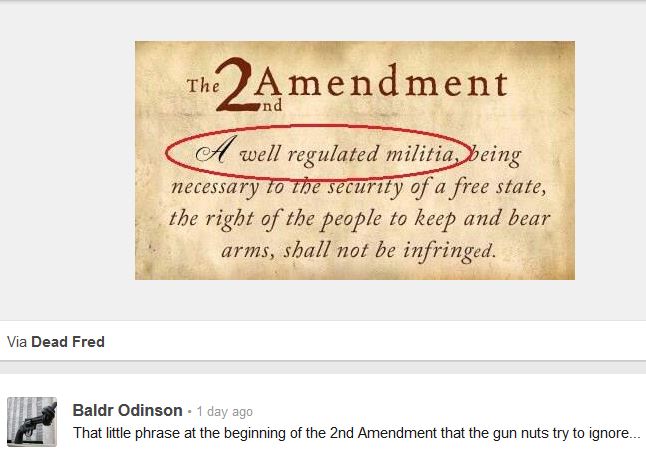
This one is really amusing:
Now Jason seems to think we ignore that part of the US Constitution, and of course HE and other gun-banners seem to think they KNOW the true meaning. It means that the Militia is the National Guard, and it should have heavy government laws against the ownership of guns to only those people serving in the National Guard, and anybody else wanting a gun can go pound sand.
Well of course those serving in the National Guard or any other American Armed Force DON’T own their issue guns, and never will, even if they get the Medal of Honor and pony up a lottery ticket’s worth of cash to BUY the weapon that they served with.
Further the National Guard didn’t exist at the time of the US Constitution, and wasn’t formed in its current state until over a century later, and really if any of the people who helped write that Amendment were around, they’d probably hate the idea. The framers didn’t like the idea of “Standing Armies” for the exact reason why we shouldn’t like our modern militarized SWAT teams.
I don’t think they’d really mind our ACTUAL standing armies because unlike SWAT teams they are DEPRIVED of all rights to arms while state-side, hence why the terrorist attack on Ft. Hood was such a blood bath. Everybody who was shot that day was more than capable of killing the rampaging terrorist….well they would be if the tools they were trained with weren’t locked up in armories, or they were allowed access to their personal arms.
Further Jason seems to not understand that there is a thing called “Google”, and he could actually look stuff up.
If Google still had the “I’m feeling Lucky” button it would take you here:
The following are taken from the Oxford English Dictionary, and bracket in time the writing of the 2nd amendment:
1709: “If a liberal Education has formed in us well-regulated Appetites and worthy Inclinations.”
1714: “The practice of all well-regulated courts of justice in the world.”
1812: “The equation of time … is the adjustment of the difference of time as shown by a well-regulated clock and a true sun dial.”
1848: “A remissness for which I am sure every well-regulated person will blame the Mayor.”
1862: “It appeared to her well-regulated mind, like a clandestine proceeding.”
1894: “The newspaper, a never wanting adjunct to every well-regulated American embryo city.”
The phrase “well-regulated” was in common use long before 1789, and remained so for a century thereafter. It referred to the property of something being in proper working order. Something that was well-regulated was calibrated correctly, functioning as expected. Establishing government oversight of the people’s arms was not only not the intent in using the phrase in the 2nd amendment, it was precisely to render the government powerless to do so that the founders wrote it.
Ouch!
Further you don’t need to just hang onto those 27 words, the guys who wrote the Bill of Rights also wrote other stuff. Books, papers, articles, and correspondence where they talked about their ideas of liberty, government, and ownership of individual weapons. These thoughts were shared as they came up with the most succinct writing of the 2nd Amendment.
Even worse for the poor, ignorant Antis are State Constitutions, specifically those here in the East that were written BEFORE the bill of rights.
Like Massachusetts, you know where John Addams lived, and we have Mass Graves of British soldiers that are all nicely marked with plaques:
The people have a right to keep and to bear arms for the common defence. And as, in time of peace, armies are dangerous to liberty, they ought not to be maintained without the consent of the legislature; and the military power shall always be held in an exact subordination to the civil authority, and be governed by it. Pt. 1, art. 17 (enacted 1780).
I also really dig on Vermont’s:
That the people have a right to bear arms for the defence of themselves and the State — and as standing armies in time of peace are dangerous to liberty, they ought not to be kept up; and that the military should be kept under strict subordination to and governed by the civil power. Ch. I, art. 16 (enacted 1777, ch. I, art. 15).
Yeah, we never gave that little bit a lick of thought, Jason.
What’s your excuse when it comes to the “Shall Not Be Infringed”? Does that part just not count?